Imagine spending an entire day spraying one field, only to realize that some rows received too much chemical while others received too little. For many Indian farmers, manual spraying can mean exactly that more labor, more walking, and inconsistent coverage. But does switching to an agriculture sprayer machine automatically mean lower pesticide use and faster work? Not always. The real difference comes from coverage, nozzle setup, field size, crop type, and how accurately the machine is operated. Let’s compare the two approaches on the factors that matter most to a farmer: time, pesticide use, labour, coverage and operating cost.
1. Time: How Much Faster Can Mechanized Spraying Be?
Time becomes critical when pests or diseases are spreading quickly.
Manual spraying with a knapsack or hand-operated sprayer requires the operator to repeatedly walk through the crop, refill the tank and maintain a consistent spraying pattern. On larger farms, this can turn one spraying operation into a multi-day task.
Mechanized spraying changes the equation by covering a wider area with every pass.
ICAR has highlighted the importance of timely and uniform plant-protection application. In one of its crop-management publications, it notes that “timely and uniform application of plant protection chemicals is important”, particularly where delays can lead to significant crop losses.
A boom-equipped agriculture sprayer machine can cover several rows at once. MITRA’s Cropmaster Boom, for example, is available with boom spans of 20 or 30 feet on specific variants, allowing considerably wider coverage than a person carrying a spray lance. The Cropmaster range also includes 200- and 400-litre configurations.
For a farmer with a large open field, that wider coverage can mean fewer passes and less time spent walking between crop rows.
2. Pesticide Use: Where Can the Saving Come From?
Saving pesticide does not simply mean putting less chemical into the tank.
The goal is to deliver the recommended dose evenly across the target crop. Manual spraying can vary with operator speed, nozzle height, walking pattern and fatigue. If one section gets excessive spray while another receives insufficient coverage, the farmer may end up spending more without getting better protection.
A properly calibrated tractor mounted sprayer can improve consistency because the boom maintains a defined nozzle arrangement and operating pattern.
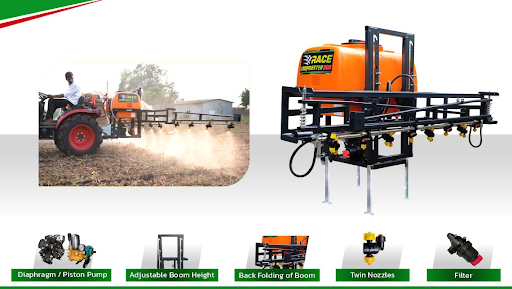
MITRA’s Cropmaster Boom uses adjustable nozzles and boom-height adjustment. Its product specifications list height adjustment up to 6 feet, while the nozzle arrangement can be adjusted according to crop row spacing. MITRA also lists “proven chemical saving” among the product benefits.
That distinction is important: the machine itself doesn’t guarantee pesticide savings; accurate application is what creates the opportunity for savings.
ICAR research also demonstrates how advanced spraying technology can reduce input use. Its annual report describes an air-assisted electrostatic sprayer that reduced pesticide use by 30% in the reported evaluation while improving application efficiency.
3. Spray Uniformity Can Matter More Than Speed
A faster spray is not useful if the crop is poorly covered.
The spray pattern needs to match the crop. Open-field crops, vineyards and orchards have completely different canopy structures, which is why there is no single best sprayer for every farm.
For crops such as soybean, cotton, chilli, pulses and sugarcane, a boom arrangement can provide broad horizontal coverage. MITRA’s Cropmaster Boom is designed for these types of ground crops and offers adjustable boom height and nozzle spacing.
Orchards are different.
A grape or pomegranate canopy may require air-assisted spraying to help droplets reach different parts of the plant. MITRA’s Bullet is designed for orchard crops including grapes, pomegranate, orange, mango, guava and custard apple. It uses an air conveyor system and fan-assisted airflow to distribute spray through orchard canopies.
This is why choosing an agriculture sprayer machine should begin with the crop rather than the machine’s tank capacity.
4. Labour and Operator Fatigue: The Hidden Cost
Manual spraying has another cost that is easy to overlook: human effort.
Carrying a loaded sprayer, walking through rows and repeatedly pumping or controlling the spray can become physically demanding, particularly during peak spraying periods.
Mechanization reduces the amount of walking and manual handling required. ICAR’s recent work on mechanized spraying repeatedly highlights labour scarcity, operator fatigue and efficiency as reasons for adopting improved spraying systems. Its 2025 farmer-innovation publication, for example, describes a mechanized weeder-cum-sprayer as a response to labour shortages and time-consuming manual operations.
A tractor-mounted system can also keep the operator seated while the implement handles the spraying operation.
MITRA’s tractor mounted sprayer range is designed around this principle. The Bullet, for example, uses a 200-litre tank and is available for tractors starting from specified lower horsepower ranges depending on configuration.
For farmers managing larger areas, reducing operator fatigue can be just as valuable as reducing hours in the field.
5. When Can Manual Spraying Still Make Sense?
Manual spraying is not automatically outdated.
For very small plots, isolated plants, difficult corners or spot treatment, bringing a tractor and large implement may not be practical.
A farmer may also need targeted spraying when only a small section of a field has a pest or disease problem. In such situations, a knapsack or hand sprayer can be simpler and more economical.
The question is therefore not “manual or machine for everything?”
It is:
Where will mechanization give the biggest return?
If you repeatedly spray large areas, the value of mechanization becomes easier to justify. If your spraying requirement is occasional and highly localized, manual equipment can still have a place.
6. Which MITRA Sprayer Fits Different Farm Requirements?
MITRA has developed a broad portfolio rather than relying on one universal spraying machine. Its current range includes tractor-mounted sprayers, tractor-trailed sprayers, boom sprayers, reel sprayers, air-blast sprayers, dusters and newer spraying technologies.
MITRA Cropmaster Boom
For open-field crops, the Cropmaster Boom is one of the most relevant options. The range includes 200- and 400-litre variants, with selected models offering 20- or 30-foot boom spans. The system is designed for uniform coverage and can work with tractors from specified horsepower levels depending on configuration.
MITRA Bullet
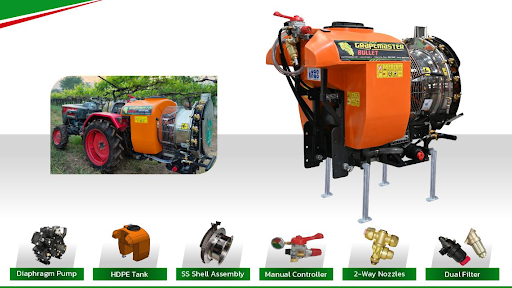
For vineyards and orchards, the Bullet uses air-assisted spraying rather than relying only on a conventional boom. MITRA lists applications for grapes, pomegranate, orange, mango, guava and custard apple.
MITRA Airotec Turbo
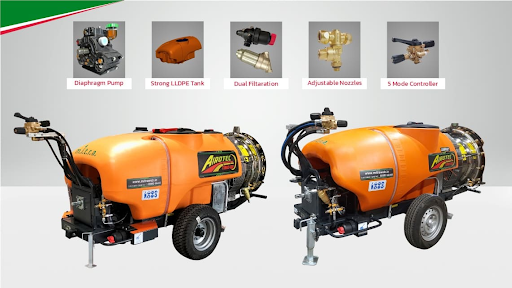
For larger orchard and vineyard operations, the Airotec Turbo range includes 400-, 600- and other configurations. Depending on the model, MITRA specifies diaphragm pumps, different fan sizes and air-output levels, with tractor requirements varying by configuration.
MITRA Thunder Fog
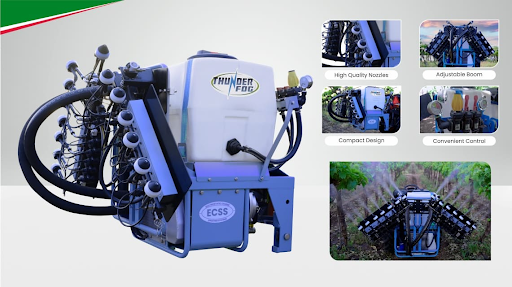
For farmers interested in precision-oriented spraying, MITRA’s Thunder Fog uses electrostatic technology. MITRA states that its system can provide 360-degree coverage and uses approximately 40 liters of water per acre, with fine droplets designed to improve adherence to plant surfaces. These are manufacturer specifications, so field performance should always be evaluated according to crop, formulation, and operating conditions.
7. 5 Checks Before Buying an Agricultural Sprayer Machine
Before choosing an agriculture sprayer machine, check these five points:
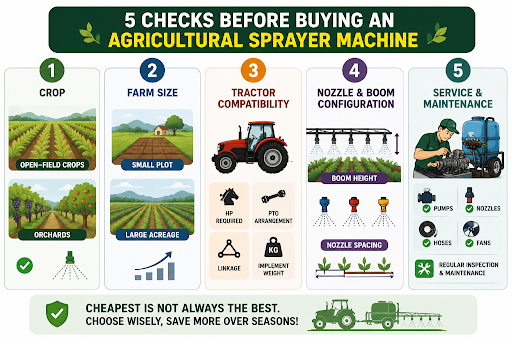
- Crop:
Open-field crops and orchards require different spraying approaches. - Farm size:
A small plot may not justify a high-capacity system, while large acreage can make wider coverage valuable. - Tractor compatibility:
Check required horsepower, PTO arrangement, linkage and implement weight. - Nozzle and boom configuration:
The nozzle spacing and boom height should match crop rows and canopy conditions. - Service and maintenance:
Look beyond the purchase price. Pumps, nozzles, hoses, fans and other components need periodic inspection and maintenance.
These factors matter because the cheapest sprayer is not necessarily the lowest-cost spraying solution over several seasons.
8. Boom Sprayer vs Manual Spraying: A Practical Comparison
Factor | Manual Spraying | Boom / Tractor Mounted Sprayer |
Area covered per pass | Low | High |
Operator walking | High | Low |
Large-field suitability | Limited | Strong |
Spray consistency | Depends heavily on operator | More controlled |
Initial investment | Lower | Higher |
Small spot treatment | Convenient | Less practical |
Labour requirement | Higher | Lower |
Row-based spraying | Depends on operator | Can be configured |
Orchard suitability | Depends on equipment | Air-assisted models available |
The table makes one thing clear: the decision is not simply about buying a bigger tank.
It is about matching the tractor-mounted sprayer or other mechanized system to the work that happens on your farm.
9. Don't Ignore Calibration
Even the best machine cannot compensate for poor setup.
Before spraying, check nozzle condition, pressure, boom height, forward speed and the required application rate. Blocked or worn nozzles can create uneven spray patterns, while excessive speed can affect coverage.
ICAR’s recent spray science work has placed particular emphasis on droplet behavior, canopy conditions, nozzle selection, and application efficiency. In 2026, ICAR-NRCG brought researchers, equipment manufacturers, and agricultural stakeholders together specifically to discuss spray dynamics and improved canopy coverage.
That shows where modern spraying is heading: not simply more spraying, but more controlled spraying.
What Should a Farmer Compare Before Switching?
If you’re deciding between manual spraying and a mechanized system, don’t compare only the purchase price.
Calculate how many acres you spray in a season, how many workers are required, how many hours each operation takes, how often spraying is repeated and how much chemical and water are currently being used.
Then consider whether a suitable agriculture sprayer machine or tractor mounted sprayer can reduce the workload while giving you more consistent application.
For farmers managing open-field crops, MITRA’s boom systems provide one route toward wider, more controlled coverage. For vineyards and orchards, its Bullet and Airotec ranges address a different spraying challenge, while newer systems such as Thunder Fog show how precision spraying is evolving.
The smarter comparison is therefore not simply boom versus manual. It is about matching the right spraying technology to your crop, acreage, tractor, labour availability and application requirements and measuring what changes after you make the switch.