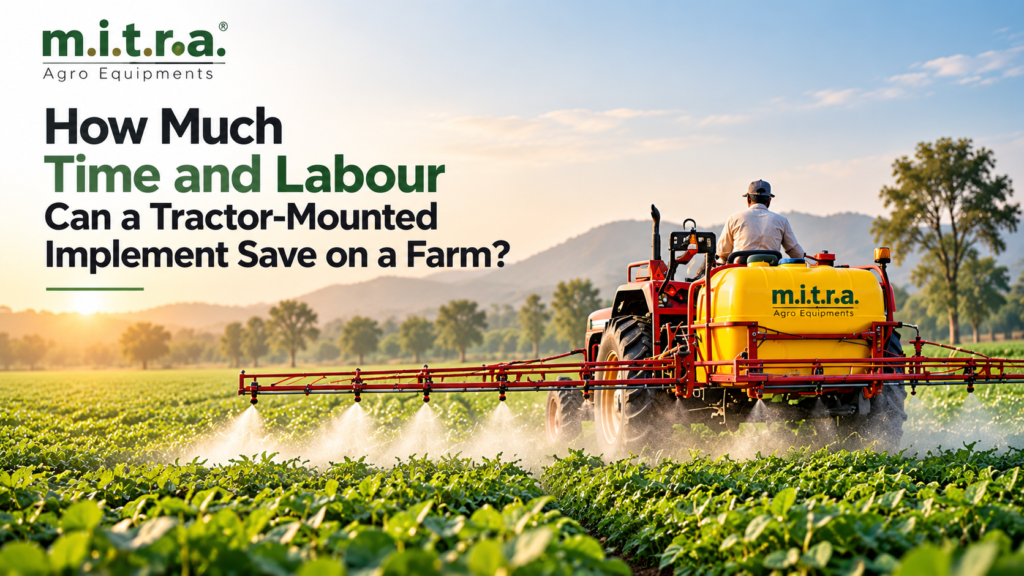
Every spraying round on a farm has a hidden cost: not just the chemical in the tank, but the hours spent finding labour, carrying equipment, walking rows and repeating the job. For an Indian farmer managing a large field or commercial orchard, the real question is not simply “Which sprayer should I buy?” It is “How much productive farm time can I recover?” That is where an agriculture sprayer machine becomes an economic decision rather than just a machinery purchase. This guide looks at labour, time, coverage and machine choice—and how MITRA’s tractor-mounted solutions fit different Indian farming conditions.
Why Spraying Time Has Become a Farm-Management Issue
Spraying is a time-sensitive operation. A crop may need protection within a narrow window because of pest pressure, disease, weather or crop stage. If labour is unavailable, the operation can be delayed.
ICAR’s recent work continues to identify labour scarcity, time-consuming manual operations and the need for mechanisation as important challenges in Indian agriculture. In its 2025 Indian Farming article on custom hiring, ICAR reports that mechanisation can reduce time and manual labour by 20–30%, while improving timeliness and resource use.
As ICAR puts it, “agro-machinery serves as the engineering backbone” of modern agriculture. The practical question is how to apply that principle to spraying.
Manual Spraying vs Mechanised Spraying
Consider a 20–25 acre farm. With a knapsack sprayer, several workers may be needed to mix inputs, refill tanks and cover the field. Operators also have to walk through the crop, stop for refilling and maintain a consistent pace.
A tractor-mounted sprayer changes the workflow. The tractor provides movement and power while the implement handles application across a wider working area. Labour can then be shifted away from physically carrying and operating individual sprayers.
The exact saving depends on crop, row spacing, terrain, spray volume, tractor speed, implement width and refill logistics. So avoid relying on a generic “X acres per hour” claim without checking your own conditions.
A better calculation is:
Time saved = manual spraying hours − mechanised spraying hours
Labour saved = manual workers required − mechanised workers required
Then multiply the hours and labour reduced by your actual local cost.
How a Tractor-Mounted Sprayer Can Save Time
The biggest advantage is field capacity. Instead of an operator carrying a tank and walking behind a manual sprayer, the tractor covers the field while the implement distributes the spray.
For row crops, MITRA’s Cropmaster range is designed for tractor-mounted boom spraying. The Cropmaster 200 L and 400 L models are listed for soybean, tur, chilli, cotton, sugarcane, cereals, potato and pulses. The 400 L version has a 30-foot boom, height adjustment up to 6 feet and is designed for tractors of 40 HP and above.
The benefit is therefore not simply speed. It can also mean fewer walking hours, fewer individual tanks to refill and a more repeatable spraying process.
Orchard Spraying Needs a Different Approach
An orchard is not the same as a soybean or cotton field. Trees have height, canopy density and internal foliage, so a simple boom is not always the right tool.
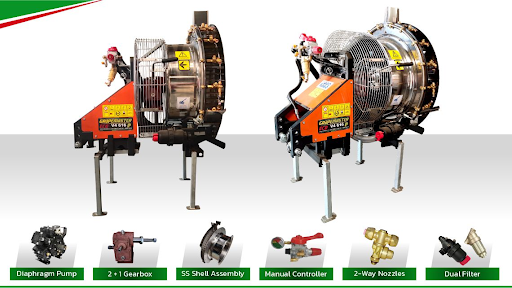
MITRA’s air-blast and tractor-trailed range is designed for crops including grapes, pomegranate, orange, mango, guava, apple and other orchards. Its Airotec Turbo range includes 400 L, 600 L, 800 L, 1000 L, 1500 L and 2000 L variants, with different tractor-power requirements and nozzle/fan configurations.
The Mitra Bullet is another tractor mounted sprayer for crops such as grapes, pomegranate, orange, mango, guava and custard apple. The standard Bullet listed by MITRA has a 200-litre tank, 55 LPM diaphragm pump, 10 nozzles and a 550 mm fan, with tractor suitability from 18 HP.
The important point is that the right tractor mounted sprayer is determined by the crop and spraying job, not by tank size alone.
The Second Saving: Reducing Dependence on Labour
Labour is not just a wage line. It includes availability, coordination and the risk of missing the right spraying window.
The Ministry of Agriculture and Farmers Welfare continues to publish annual agricultural wage data, making labour cost an important operating consideration for farm economics. ICAR has also highlighted custom hiring as a way to reduce the capital burden, improve machine utilisation and lower per-unit costs.
For larger farmers, ownership can make sense when the machine will be used frequently. For smaller farmers, a Custom Hiring Centre, FPO or shared-machinery arrangement can spread the cost across multiple users.
In February 2026, ICAR reported a Custom Hiring Centre initiative intended to reduce labour dependency and improve operational efficiency for hundreds of member farmers.
This makes mechanisation more accessible without requiring every farmer to own every implement.
Better Coverage Can Also Mean Better Economics
Saving labour is only half the equation. Spraying quality matters.
MITRA says its sprayers are designed for accurate chemical delivery and uniform coverage, with different controllers and nozzle arrangements depending on the application. Its agriculture sprayer machine range also includes different tank capacities and air-conveyor systems for suitable orchard applications.
For ground crops, the Cropmaster boom sprayer offers adjustable boom height and nozzle arrangements. For orchards, air-assisted systems are designed around canopy spraying rather than simple horizontal coverage.
This distinction matters because poor coverage can lead to repeat applications. A cheaper spraying method is not necessarily cheaper if the job has to be repeated.
What About Drones?
Drone spraying is one of the most visible developments in farm mechanisation. ICAR’s 2025 farmer advisories note that drones can reduce spraying time and cost and cite an example of a 10-litre drone covering an acre in 6–10 minutes under specified conditions.
But that does not make drones a universal replacement for tractor equipment.
Farmers should compare crop type, acreage, canopy, terrain, spray requirement, battery and logistics, service availability and operating economics.
A tractor mounted sprayer can be particularly practical where a farmer already owns a compatible tractor and needs repeated spraying across larger areas. In orchards, air-assisted systems address a different application requirement.
The smarter approach is not “tractor versus drone.” It is choosing the application system that fits the farm.
How to Calculate Whether an Agriculture Sprayer Machine Is Worth It
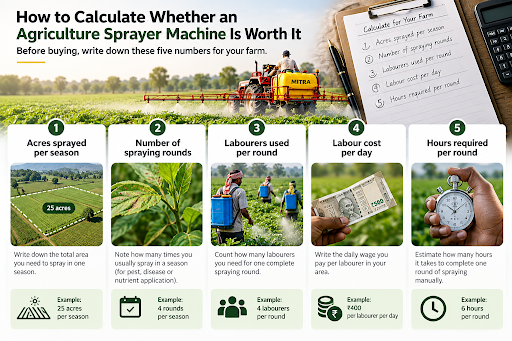
Before buying, write down five numbers:
- Acres sprayed per season
- Number of spraying rounds
- Labourers used per round
- Labour cost per day
- Hours required per round
Then add machine-related costs: purchase or rental, tractor operating cost, maintenance, depreciation and financing.
If mechanisation reduces the number of workers required and allows spraying to finish earlier, the benefit is not limited to wages. The farmer also gains flexibility to respond to weather, pest pressure and crop-stage requirements.
If ownership is uncertain, hire a machine for a season and measure acres covered, labour hours, diesel use, refill time and spraying quality before buying.
Choosing the Right MITRA Solution
MITRA’s range covers several spraying requirements rather than one universal machine. Cropmaster models are relevant to ground crops where boom spraying is appropriate. Bullet and 3-point-linkage options target tractor-mounted orchard and vineyard applications. Airotec Turbo models extend into larger tractor-trailed air-blast applications for orchards and plantations. MITRA also offers reel sprayers and dusters for specific farm operations.
For a farmer evaluating a tractor mounted sprayer, the useful comparison is not simply purchase price. Look at total operating hours, labour dependency, field capacity, coverage consistency and expected utilisation across the season.
The right agriculture sprayer machine should match your tractor HP, crop spacing, canopy structure, acreage, water requirement and terrain.
Farm mechanisation is increasingly about doing more with the resources already available. Labour availability will vary, weather windows will remain unpredictable, and delayed crop protection can carry a cost. A well-matched sprayer can make spraying more predictable, measurable and manageable.
The real value is not simply a machine working in the field. It is gaining greater control over one of the farm’s most time-sensitive operations.