Rain can bring relief to a farmer, but it can also make pesticide spraying much more complicated. You may have the right chemical, the right dose and the right agriculture sprayer machine, yet a sudden shower can wash away the effort before the spray has done its job. During India’s monsoon season, changing humidity, wet leaves, wind and unpredictable showers make spray timing and application especially important. Here are five common mistakes farmers should avoid and what to do instead.
Mistake 1: Spraying Just Before or During Rain
This is one of the most expensive mistakes because the farmer may pay for the chemical, labour and diesel without getting the intended crop protection.
If rain arrives soon after spraying, droplets can be diluted or washed from leaf surfaces before sufficient deposition or absorption takes place. The exact rain-free period depends on the pesticide formulation and label directions, so there is no universal “wait X hours” rule.
ICAR’s agrometeorological advisories have repeatedly recommended spraying during clear weather. One advisory specifically recommends a rain-free period during spraying and at least six hours after spraying for the situation covered by that advisory.
The practical lesson is simple: don’t look only at whether it is raining right now. Look at the weather window after application too.
Before operating an agriculture sprayer machine, check the local forecast and the pesticide label. If rain is highly likely immediately after spraying, postponing the operation may prevent a wasted application.
What to do instead
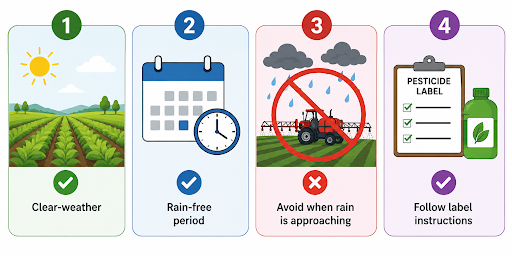
- Choose a clear-weather window whenever the product label permits.
- Check the expected rain-free period after application.
- Avoid spraying when rain is already approaching.
- Follow the pesticide label rather than relying on a fixed rule for every chemical.
Mistake 2: Ignoring Wet Leaves, Humidity and Wind
Rain is not the only weather factor that matters.
After a shower, leaves may remain wet for hours. High humidity can also change how droplets behave on the crop. Wind can carry fine droplets away from the target area, reducing deposition and potentially increasing off-target drift.
This is becoming an increasingly important area of agricultural research. In February 2026, ICAR-National Research Centre for Grapes in Pune organised a dedicated workshop on spray science, bringing together scientists, sprayer and nozzle manufacturers, agrochemical companies and farmers. Discussions focused on droplet behaviour, spray dynamics, canopy coverage and choosing suitable sprayers and nozzles for different crop conditions.
That focus reflects an important shift in modern spraying: the question is no longer simply “How much pesticide should I spray?” It is also “Where are the droplets going, and how well are they reaching the crop?”
What to do instead
Before using a tractor mounted sprayer, check:
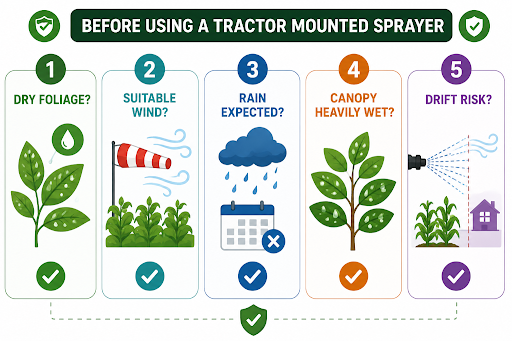
- Is the crop foliage sufficiently dry?
- Is wind speed suitable for spraying?
- Is rain expected soon?
- Is the canopy already heavily wet?
- Is the spray likely to drift outside the target area?
A few minutes spent checking conditions can prevent an entire spray operation from being compromised.
Mistake 3: Using the Wrong Nozzle, Pressure or Spray Pattern
Two farmers can use the same pesticide and the same tank volume yet get very different results.
Why? The spray pattern matters.
Nozzle type, pressure, droplet size, boom height and forward speed all influence how the spray reaches the crop. Using excessive pressure simply because “more pressure means better spraying” can be counterproductive. Similarly, an incorrect nozzle can produce poor coverage or an unsuitable droplet pattern.
This is particularly important during the monsoon because farmers may be trying to treat dense foliage under humid conditions.
MITRA highlights accurate chemical delivery and uniform coverage as key benefits of its spraying technology. Its range uses different controllers and nozzle arrangements depending on the application.
For open-field crops, MITRA’s Cropmaster Boom range provides adjustable boom arrangements and nozzle configurations. For example, its product information describes 200- and 400-litre variants and boom options designed for different crop-row requirements.
What to do instead
Before spraying, make sure:
- Nozzles are clean and not partially blocked.
- Pressure is appropriate for the selected nozzle.
- Boom height is correctly set.
- Forward speed is consistent.
- Nozzle spacing matches the intended crop coverage.
A properly configured agriculture sprayer machine is about controlled application not simply spraying more liquid.
Mistake 4: Using the Same Sprayer for Every Crop
A cotton field and a grape vineyard may both require crop-protection sprays, but their spraying requirements are completely different.
Open-field crops generally need broad and uniform coverage across rows. Orchards and vineyards have three-dimensional canopies where leaves may be positioned at different heights, angles and depths.
Trying to treat both situations with the same spraying approach can reduce coverage and increase wastage.
This is where selecting the right tractor mounted sprayer becomes important.
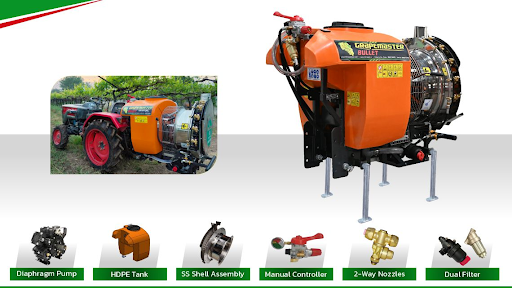
MITRA’s product portfolio includes different systems for different crop structures. Its Cropmaster Boom and Cropmaster Reel systems are aimed at ground crops, while the Bullet and Airotec ranges are designed for orchard and vineyard applications. MITRA lists crops such as grapes, pomegranate, mango, orange and guava across its horticulture-focused product range.
The MITRA Bullet, for example, uses an air-assisted system designed to help move spray into orchard canopies. Its Airotec range similarly focuses on air-assisted spraying for horticultural crops.
What to do instead
Choose the spraying method based on:
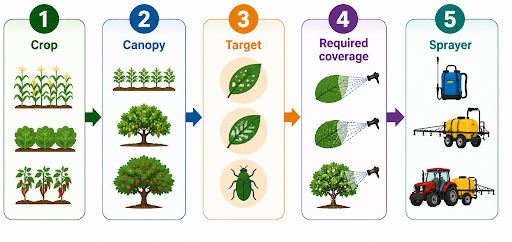
Crop → Canopy → Target → Required coverage → Sprayer
For open-field crops, a boom system may be appropriate. For dense orchard or vineyard canopies, air-assisted equipment may offer a more suitable application approach.
Mistake 5: Skipping Calibration, Cleaning and Maintenance
A sprayer can perform well when new and gradually lose performance if it is not maintained.
Worn nozzles can alter flow. Blocked filters can reduce performance. Leaking hoses can cause chemical loss. Incorrect pressure can change application rates.
MITRA recommends inspecting its agriculture sprayer machine after use, checking filters regularly, greasing parts at recommended intervals and scheduling routine service checks. Its after-sales guidance also stresses keeping components clean, replacing worn or damaged parts and never servicing equipment while it is moving.
Cleaning is particularly important when different crop-protection products are used during the season. Residues left in tanks, filters and spray lines can contaminate the next application or deteriorate components over time.
What to do instead
After every spraying operation:
- Flush the tank and spray lines as recommended.
- Clean filters and nozzles.
- Check hoses for leaks.
- Inspect the pump and pressure system.
- Store the machine safely and keep it protected.
- Follow the manufacturer’s maintenance schedule.
MITRA’s own guidance specifically recommends flushing lines, filters and the tank after use, inspecting filters and hoses regularly, and checking PTO and related components.
Why the Right Sprayer Matters During Monsoon
The rainy season creates a difficult balance. Farmers need to respond quickly when pest and disease pressure increases, but they also have fewer reliable spraying windows.
That makes equipment selection more important.
A suitable agriculture sprayer machine can help provide consistent application across larger areas, while the right tractor mounted sprayer can reduce manual effort and make repeated spraying operations more manageable.
MITRA’s range covers several requirements. The Cropmaster Boom and Reel systems target ground crops, while the Bullet, Airotec Turbo and Airotec Cyclone systems address different orchard and vineyard spraying needs. MITRA also offers the Thunder Fog electrostatic spraying system, which uses charged droplets as part of its approach to crop coverage.
The important point is not to buy the most advanced machine simply because it has more features. Choose a system that matches your crop, acreage, tractor, canopy and spraying frequency.
A Simple Monsoon Pre-Spray Checklist
Before starting your tractor mounted sprayer, take one minute to ask:
Weather: Is there enough rain-free time after spraying?
Crop: Is the foliage suitable for spraying?
Wind: Is the spray likely to remain on target?
Machine: Are the tank, pump, filters, hoses and nozzles working properly?
Settings: Are pressure, speed, boom height and nozzle configuration correct?
Chemical: Are you following the product label and recommended dose?
These checks may seem basic, but they address the main reasons a technically good spraying operation can fail.
Spray Smarter, Especially When the Weather Doesn't Cooperate
Monsoon spraying is not simply about finding a gap between two rain showers. It requires farmers to consider weather, crop condition, spray technology, equipment settings and maintenance together.
ICAR’s recent spray-science work emphasises that better application depends on understanding droplet behaviour, canopy interaction and suitable sprayer and nozzle selection.
For farmers, that means moving away from the idea that “more spray is better.” A well-maintained agriculture sprayer machine, correctly configured tractor mounted sprayer, appropriate weather window and crop-specific application method can make the spraying operation far more controlled.
And when the monsoon gives you only a short window to act, getting those basics right can make every spray count.