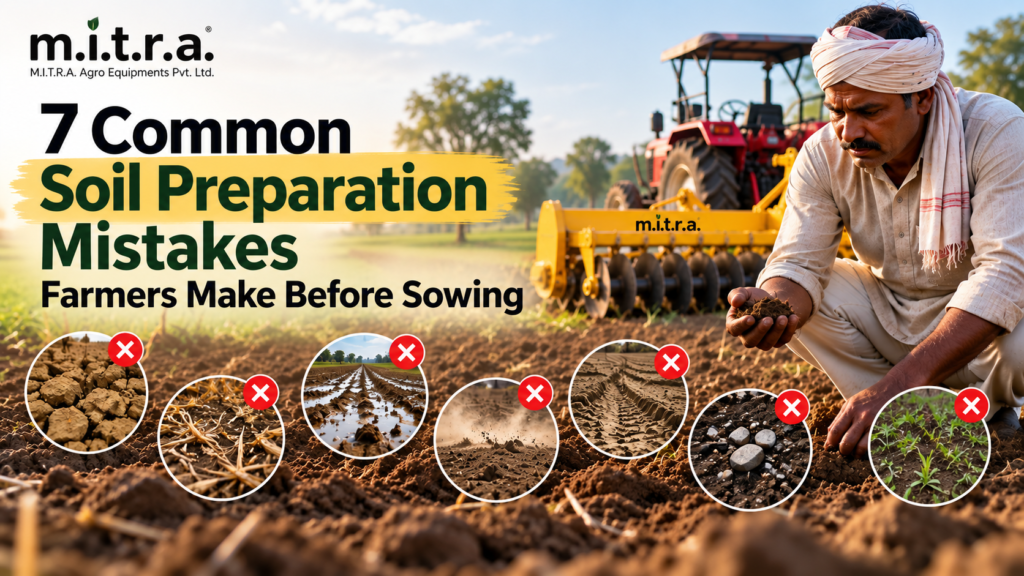
A good harvest does not begin when the first seed goes into the ground. It begins much earlier—with the condition of the soil. A field may look perfectly prepared from the tractor seat and still have compaction, poor moisture, nutrient imbalance or residue problems underneath. The result? Uneven germination, weak roots, higher input costs and more problems later in the season.
The Food and Agriculture Organization (FAO) describes soil as the foundation of agriculture and notes that around 95% of the food we eat is produced directly or indirectly from soil. For Indian farmers dealing with changing rainfall, rising input costs and labour challenges, getting soil preparation right is becoming even more important.
Here are seven common mistakes to check before sowing—and practical ways to avoid them.
1. Skipping Soil Testing Before Adding Fertilizers
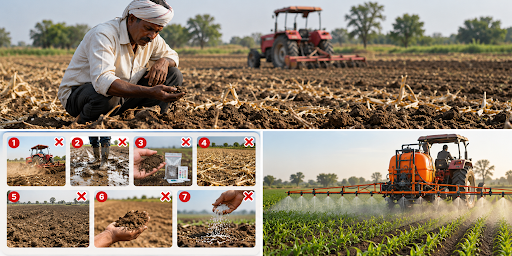
One of the most expensive assumptions a farmer can make is: “The soil needs the same fertilizer as last season.”
It may not.
Nutrient levels can change based on the previous crop, fertilizer application, irrigation, residue management and soil type. Applying fertilizer without understanding the soil can lead to unnecessary expenditure or nutrient imbalance.
ICAR’s recent farmer programmes have repeatedly promoted soil-test-based fertilizer recommendations and the use of Soil Health Cards. Its 2026 guidance specifically emphasizes balanced nutrient management based on scientific soil analysis.
What to do instead:
- Take representative soil samples before the crop season.
- Check the Soil Health Card or laboratory report.
- Understand pH, organic carbon and major nutrient status.
- Apply nutrients according to the crop requirement and soil-test recommendation.
Think of it as “test before you invest.” Money spent on an unnecessary input is still a farm cost.
2. Tilling the Field Too Much
More passes with a tractor do not automatically mean better soil.
Repeated or unnecessary tillage can break down soil structure, increase disturbance and consume additional fuel and time. ICAR has recently cautioned farmers against repeated and indiscriminate rotavator use because excessive soil pulverisation can contribute to shallow hardpan formation and deterioration of soil structure.
The objective should be to create the right seedbed—not powder the entire field.
Depending on the crop, soil type and farming system, reduced tillage, conservation tillage, residue retention or other appropriate practices may be more suitable.
Before making another tractor pass, ask:
- Is the soil actually compacted?
- Does the crop require deeper tillage?
- Is the existing seedbed already suitable?
- Will another pass improve establishment enough to justify the fuel and labour?
Good soil preparation is about precision, not repetition.
3. Working the Soil at the Wrong Moisture Level
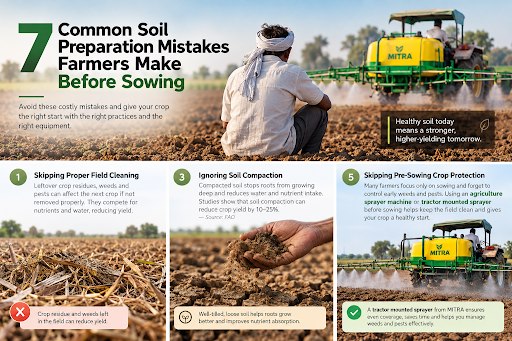
Soil moisture is one of the easiest things to overlook because the field may look workable from the surface.
Working very wet soil can cause compaction and smearing. Working extremely dry soil can require more power and may create large clods or excessive dust.
The right condition depends on soil type and the operation being performed. The farmer should check the soil physically before deciding whether to till, level or prepare the seedbed.
This matters particularly in rainfed farming. FAO notes that around 50% of India’s net sown area is rainfed, making soil-water management especially important for Indian agriculture.
Practical check: Take a handful of soil from the working depth and assess whether it crumbles appropriately rather than sticking heavily together or collapsing into dust.
4. Removing or Mishandling All Crop Residues
Crop residue is not automatically waste.
Stalks, leaves and other organic material can contribute to soil cover and organic matter when managed appropriately. FAO notes that organic matter influences soil structure, water-holding capacity, nutrient availability and biological activity.
At the same time, simply leaving bulky residues scattered across the field can interfere with sowing and field operations.
The better approach is management rather than blanket removal.
For orchards and farms producing woody material, equipment such as MITRA’s can process branches into smaller chips that can potentially be reused for mulching, composting or soil conditioning. MITRA states that the machine is designed for 24 HP-and-above tractors and produces uniform chips suitable for such reuse.
The goal is to turn farm residue from a disposal problem into a useful farm resource wherever the cropping system allows it.
5. Ignoring Soil Compaction, Drainage and Levelling
Seeds need more than loose soil. They need the right balance of air, water and root space.
Compacted layers can restrict root development and water movement. Poor levelling can create areas where water accumulates while other parts of the field remain too dry.
This is why soil preparation should not stop at “the field looks flat.”
Walk the field and identify:
- Waterlogging-prone patches
- Hard or compacted zones
- Uneven field levels
- Areas with poor infiltration
- Existing bund or drainage problems
Recent ICAR recommendations have highlighted scientific land levelling, efficient water management and appropriate tillage as important components of sustainable crop establishment.
A uniform field gives the crop a more uniform starting environment.
6. Treating Weeds and Early Pest Pressure as an Afterthought
Another common mistake is thinking crop protection starts only after the crop becomes visibly affected.
Early weed competition can take resources away from young plants. Pest and disease pressure can also develop before farmers notice obvious symptoms.
Crop protection should therefore be part of the overall crop plan—not an emergency response.
This is where the right agriculture sprayer machine becomes useful once the crop and application stage require it. The purpose is not simply to spray faster; it is to achieve appropriate coverage and application according to the crop, product label and agronomic recommendation.
For row crops, MITRA’s Cropmaster Boom range is designed for crops including soybean, tur, chilli, cotton, sugarcane, cereals and pulses. Its configurations include 200–600 litre tanks, adjustable boom widths and height adjustment depending on the model.
7. Choosing Spraying Equipment Only for Speed
A machine that finishes the job quickly is not necessarily the machine that performs the job correctly.
Farmers should consider crop type, field size, tractor compatibility, terrain, canopy structure, tank capacity, nozzle configuration and required coverage before choosing an agriculture sprayer machine.
For broad-acre and row-crop applications, a tractor mounted sprayer can help mechanise spraying and improve operational efficiency. But the equipment must match the application.
MITRA’s Cropmaster Reel models, for example, combine a reel and boom configuration and are available in 200, 400, 500 and 600 litre versions. Depending on the model, the system can provide long hose reach and boom widths suited to different field requirements.
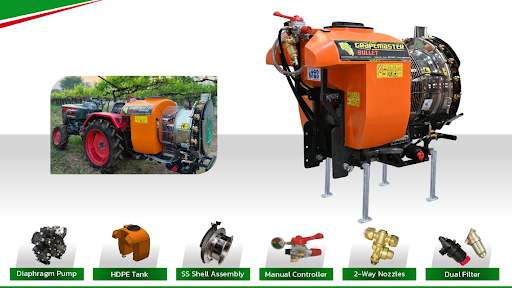
For orchard farmers, the requirement is different. MITRA’s Bullet is an air-assisted tractor mounted sprayer designed for orchard crops such as grapes, pomegranate, orange, mango, guava and custard apple. Its air-conveyor system is designed to distribute airflow through the canopy, while the machine uses a 200-litre tank and tractor-mounted configuration.
In other words, don’t ask only, “How quickly can this machine spray?”
Ask, “Is this machine designed for my crop and application?”
How MITRA Fits Into a More Efficient Farm Operation
Soil preparation and crop protection are connected, even though they are different operations.
A well-prepared field helps establish the crop. The right equipment then helps farmers manage the crop efficiently through its growth stages.
MITRA’s range includes air-assisted orchard sprayers such as Bullet and Airotec models, Cropmaster boom and reel systems for field crops, and Storm Duster for powder application in vineyards and orchards.
For farmers, the larger lesson is simple: equipment should solve a specific field problem.
Whether that means improving residue management, reducing unnecessary labour, achieving more consistent spraying or choosing equipment suited to a particular crop, mechanisation works best when it is part of a planned farming system.
Pre-Sowing Checklist for Indian Farmers
Before putting the first seed in the soil, quickly check:
- Has the soil been tested?
- Are fertilizer decisions based on the soil and crop requirement?
- Is the field being tilled only as much as necessary?
- Is soil moisture suitable for the planned operation?
- Have residues been managed properly?
- Are compacted or poorly drained areas identified?
- Is the field sufficiently level for efficient water management?
- Have early weed and pest risks been considered?
- Is the planned agriculture sprayer machine appropriate for the crop?
- Is the tractor mounted sprayer correctly matched to the tractor, field and application?
.
Final Thought
Before sowing, farmers naturally focus on seed quality, fertilizer, labour and timing. But all of those decisions eventually depend on one thing: the condition of the field where the crop has to grow.
The smartest approach is not to do more work, it is to do the right work at the right time.
That means testing the soil before spending on nutrients, avoiding unnecessary tillage, protecting moisture, managing residues, correcting field constraints and planning crop protection before problems become costly.
And when mechanisation is required, the right tractor mounted sprayer or other farm implement should be selected according to the crop and actual field requirement—not simply because it is faster or bigger.
MITRA’s range of crop-specific spraying solutions reflects this same principle: modern farm equipment should make agricultural operations more efficient, consistent and practical for Indian farmers.